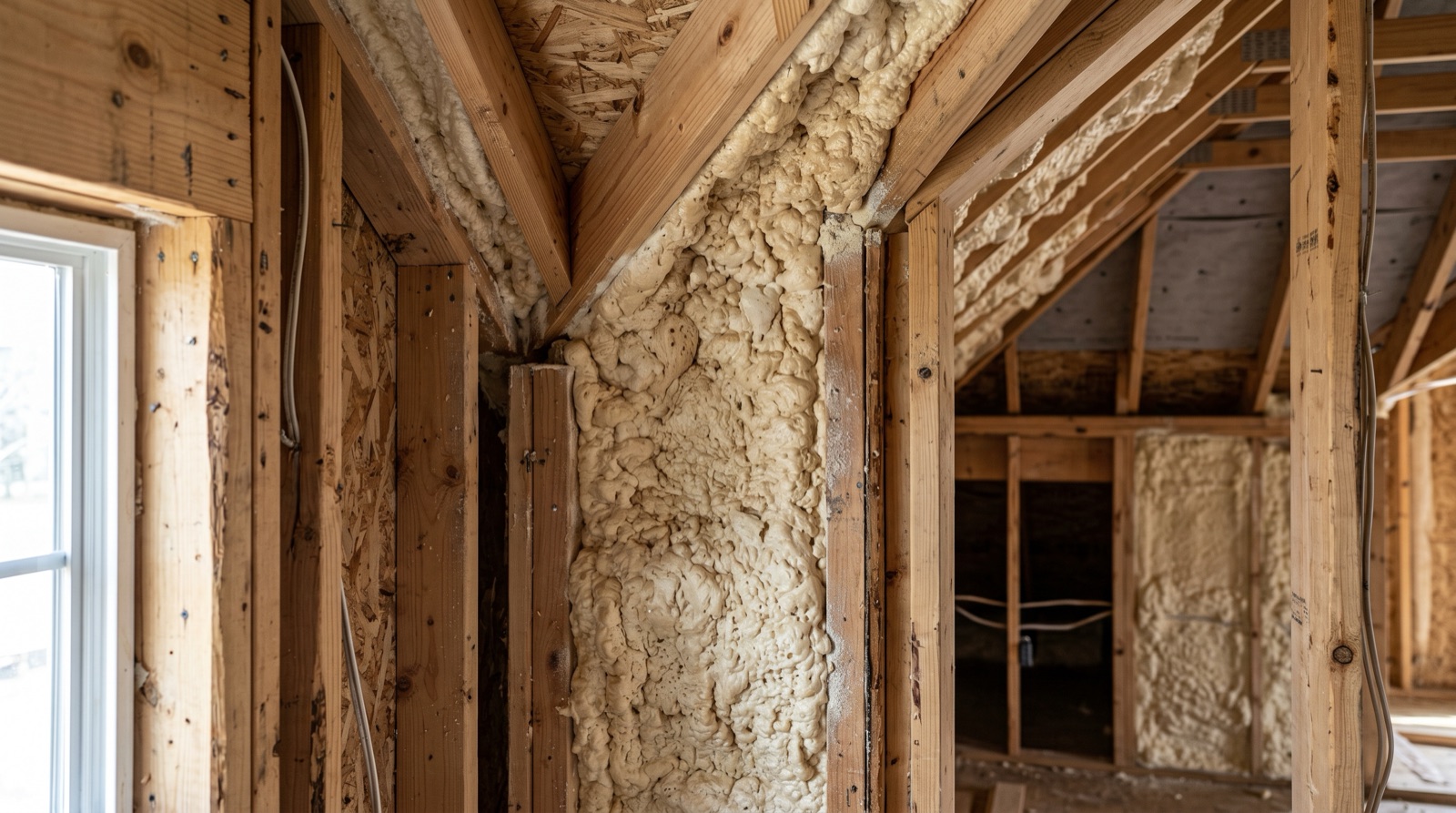
Nearly every spray foam job in Iron County comes down to two products: open-cell and closed-cell. They're both polyurethane foams sprayed as a liquid that expands and cures in place, and they both air-seal far better than fiberglass batts. But they behave differently enough that using the wrong one in the wrong spot wastes money — or, in a cold-climate roof, can trap moisture. This page compares them plainly so you can read a quote and know what you're paying for. For the broader picture, start with our spray foam insulation overview.
The one-line answer
Open-cell is the softer, lighter, cheaper foam that's excellent at filling deep cavities and quieting a house. Closed-cell is the denser, higher-performance foam that packs more R-value into less space, blocks water and vapor, and even stiffens the structure — at a noticeably higher price. In Cedar City's high desert, closed-cell tends to earn its keep in attics at the roofline, crawl spaces, rim joists, and metal buildings; open-cell shines in interior walls and generous new-construction cavities where budget and sound matter more than moisture control.
Open-cell vs. closed-cell: the full comparison
Here is how the two foams stack up on the factors that actually change a Cedar City project. Figures are typical industry ranges; a manufacturer's data sheet governs any specific product.
| Factor | Open-cell | Closed-cell |
|---|---|---|
| R-value per inch | ~R-3.5 to R-3.8 | ~R-6 to R-7 (often cited ~R-6.5) |
| Density | Light — about 0.5 lb/ft³ | Rigid — about 2 lb/ft³ |
| Air barrier | Yes, at roughly 3.5″+ | Yes, at roughly 1.5″+ |
| Vapor behavior | Vapor-permeable — not a vapor retarder | Class II vapor retarder at ~1.5–2″ |
| Bulk water | Absorbs and holds water | Rejects water (FEMA flood-resistant material) |
| Expansion / yield | Expands aggressively — fills deep, irregular cavities cheaply | Expands less — more passes for the same depth |
| Sound damping | Better at softening airborne noise | Some, but stiffer and less absorptive |
| Structural rigidity | Adds little strength | Adds racking strength to walls and roof decks |
| Relative installed cost | Lower | Higher — roughly 2x per equivalent job |
| Best-fit applications | Interior walls, sound walls, large new-build cavities | Roofline, crawl space, rim joist, metal buildings, tight spaces |
Ranges are typical for the two foam families and can vary by manufacturer and installed thickness. The right choice for one part of a home is often the wrong choice for another — a good quote specifies foam type and thickness area by area.
What R-value per inch means in Iron County
Iron County sits in IECC/ASHRAE Climate Zone 5B — cold and dry. Utah's adopted energy code targets roughly R-49 in the attic or roof assembly, about R-20 in wood-frame walls (or R-13 cavity plus R-5 continuous exterior), and R-30 over unconditioned crawl spaces. Those numbers are the frame every quote should reference; the U.S. Department of Energy's insulation guide is a good neutral reference for the zone map and recommended levels.
The R-value-per-inch gap is why foam choice changes the job. To reach an R-49 roof deck with closed-cell at ~R-6.5 takes roughly 7.5 inches; with open-cell at ~R-3.6 it takes closer to 13–14 inches — often more depth than the rafters hold without furring them out. That's a big reason closed-cell is common at Cedar City rooflines and in shallow bays, while open-cell is a natural fit inside deep 2x6 walls where there's room to spare. One honest caveat: because foam air-seals as it insulates, the finished assembly usually performs better than its nominal R-value alone would predict — but your installer still sizes thickness to the code R-value for the assembly, not to the air seal.
Where open-cell is the smart pick
- Interior and sound walls. Its softer structure absorbs airborne noise well — a common request for media rooms, shared walls, and bedrooms.
- Deep new-construction cavities. With framing open before drywall, open-cell fills a 2x6 wall or a vaulted ceiling economically and to full depth.
- Budget-driven square footage. When you need to seal a lot of area and the space isn't moisture-exposed, open-cell stretches the budget further.
The catch is water. Open-cell is vapor-permeable and will hold bulk water, so it's the wrong product against foundations, in crawl spaces, or sprayed directly to a cold roof deck without a vapor-control strategy.
Where closed-cell earns the premium
- Roofline / unvented attics. High R per inch fits the depth, and its low vapor permeability protects cold sheathing through a snowy Cedar City winter.
- Crawl spaces and rim joists. It rejects ground and bulk moisture and seals the leakiest band of the house. See our crawl space and rim-joist guide.
- Metal buildings and shops. Sprayed to the underside of steel it stops the condensation that makes bare panels “rain” indoors. See metal building insulation.
- Tight or flood-prone spaces. More R in less depth, plus water resistance recognized by FEMA for flood-damage-resistant construction.
The high-desert moisture footnote
Cedar City's big day-to-night temperature swings drive a lot of moisture movement through a building's shell. In a cold-dry Zone 5 climate, a roof or wall that's air-sealed but still lets vapor pass can let that vapor reach a cold surface and condense. Closed-cell doubles as its own vapor retarder, which is one reason it's favored at the roofline here. Open-cell at a roofline isn't wrong, but in this zone it usually needs a vapor-retarder coating or an assembly designed for it — a detail worth confirming in writing before the crew shows up.
What each foam costs
Spray foam is normally priced by the board foot — one square foot at one inch of thickness — so the total depends on area and how many inches the assembly calls for. Ballpark installed ranges look like this:
| Foam | Typical installed cost* |
|---|---|
| Open-cell | ~$0.45 – $0.75 per board foot |
| Closed-cell | ~$1.00 – $1.75 per board foot |
| Example: 2x6 wall, open-cell (~5.5″) | ~$2.50 – $4.00 per sq ft of wall |
| Example: 2″ closed-cell flash | ~$2.00 – $3.50 per sq ft |
*Rough ranges for planning only. Prep, access, thickness, removal of old insulation, and any thermal/ignition barrier all move the number. The only figure that applies to your building is a written, on-site quote.
A common way to get the best of both is a hybrid “flash-and-batt” or “flash-and-fill”: a thin flash of closed-cell for the air and vapor seal, then open-cell or fiberglass to reach the target R-value at lower cost. Whether that fits depends on the assembly — exactly the kind of thing the on-site provider estimate is for.
Open-cell vs. closed-cell, answered
Which foam is better for a Cedar City attic?
For an unvented attic at the roofline, closed-cell is the common recommendation here — it fits the R-value into the rafter depth and protects cold sheathing from winter moisture. If the attic floor is being insulated instead, the answer can differ. Our attic insulation guide walks through both.
Is closed-cell always worth the extra cost?
No. Where you don't need water resistance, a vapor retarder, or maximum R in minimal depth, open-cell often does the job for less. Closed-cell earns its premium in crawl spaces, rooflines, rim joists, and metal buildings — not in every interior wall.
Can both foams be used in the same house?
Yes, and it's common. A well-planned job might use closed-cell in the crawl space and at the roofline, and open-cell in interior sound walls — each foam where it fits best.
Does open-cell foam cause mold?
Foam itself isn't food for mold, but open-cell will hold water if it gets wet, so it's kept out of moisture-exposed spots. The mold question is really a water-management question, which is why any quote should address bulk water before insulation.